
Blog · March 26, 2026 · 9 min read
How to Write a Manufacturing SOP (Step by Step)
A practical playbook for writing a manufacturing SOP: the components that make one good, a clear step-by-step process, the main SOP types, and best practices.
- SOPs
- Manufacturing
- Documentation
- Quality
- Process
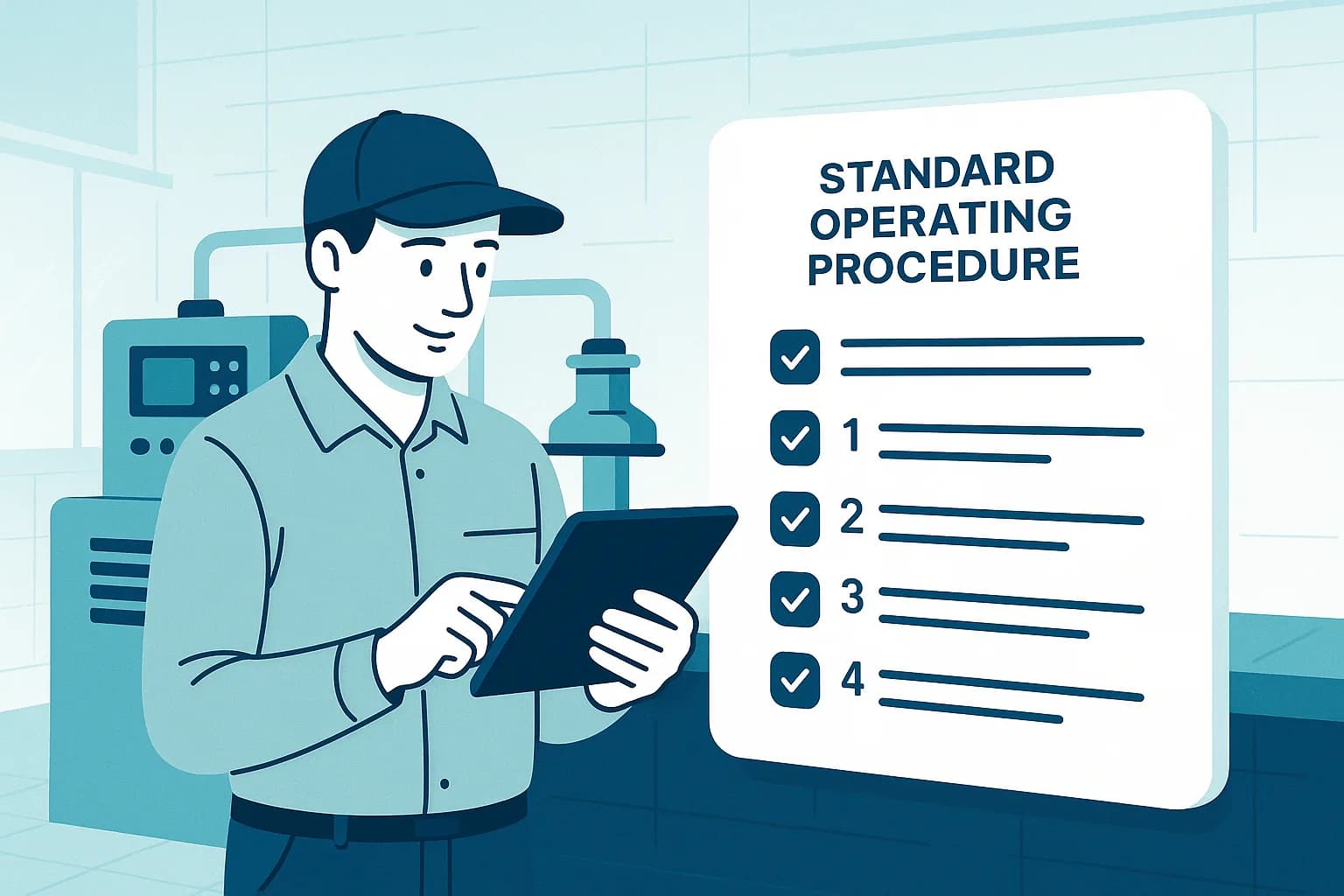
To write a manufacturing SOP, define the task and its scope, watch the person who actually does the work, capture each step as it really happens, then draft those steps in plain imperative language with photos. After that you test the draft on someone unfamiliar with the task, get it reviewed and approved, version it, and train your team. That is the whole arc, and the rest of this guide walks each part in detail.
A standard operating procedure (SOP) is a written, step-by-step description of how to perform a recurring task the same way every time. A good one is not a wall of text. It is a short, ordered, visual instruction sheet that a new operator can follow on the floor without asking for help.
Key takeaways
- A strong manufacturing SOP has a fixed anatomy: objective, scope, responsibilities, materials, step-by-step instructions, safety, quality checks, troubleshooting, and version control.
- Write it with the people who do the work, not from memory at a desk. Observe the task as it is actually performed.
- Draft in short, numbered, imperative steps (one action per step) and lean on images instead of long sentences.
- Always test the draft on someone unfamiliar with the task before you approve and publish it.
- Treat an SOP as living. Version it, train against it, and update it whenever the process changes.
What is a manufacturing SOP?
A manufacturing SOP documents a specific operation on the production floor: a machine changeover, an assembly sequence, a maintenance check, an inspection routine, a cleaning procedure. Its job is to remove variation. When everyone follows the same approved steps, output is more consistent, training is faster, and mistakes are easier to trace back to a cause.
SOPs also carry weight beyond the floor. They are the backbone of quality systems like ISO 9001, they support audits, and several manufacturing certifications depend on documented procedures. They also protect the knowledge that would otherwise walk out the door when an experienced operator retires. The goal of this guide is the practical part: how to actually write one that people use.
The components of a good manufacturing SOP
Before you write a single step, know the parts you are filling in. A complete SOP answers what, who, with what, how, how safely, and how you know it worked. Use the table below as your template skeleton.
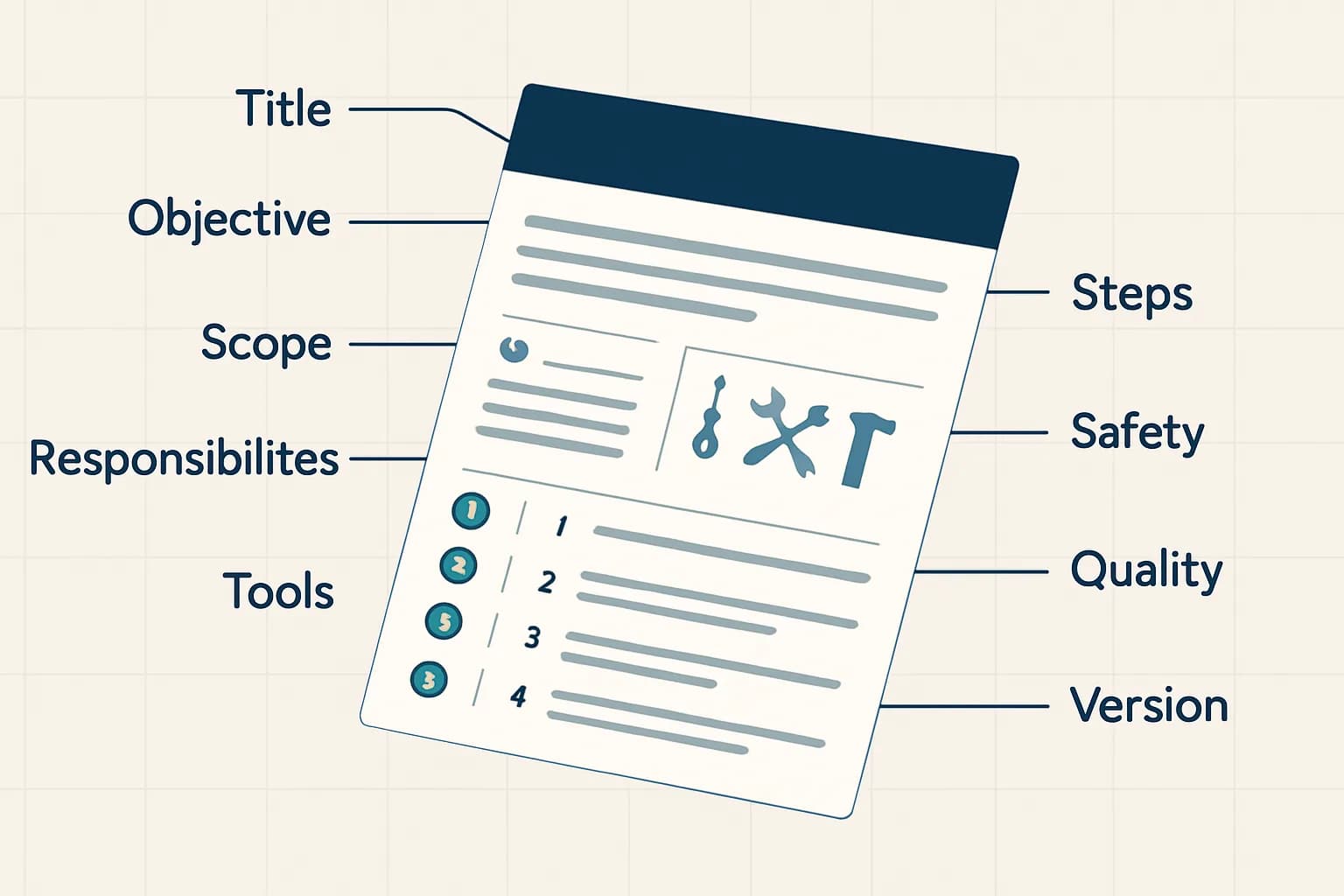
| Component | What it includes |
|---|---|
| Title and ID | A clear name, a unique document number, and the date so the SOP is easy to find and reference. |
| Objective | One or two lines on what the procedure achieves and why it matters. |
| Scope | Where the SOP applies and where it does not: which line, machine, product, or shift. |
| Responsibilities | Who performs the task, who reviews it, and who approves it. |
| Materials and tools | Every tool, material, part, and consumable the task requires, with quantities or settings. |
| Step-by-step instructions | Numbered, ordered actions, one action per step, with a photo for anything visual. |
| Safety and PPE | Hazards, required personal protective equipment, lockout/tagout, and warnings placed before the risky step. |
| Quality checks | What to measure or verify, the acceptable range, and what to do when a reading is out of spec. |
| Troubleshooting | Common problems, their likely causes, and the fix or the person to escalate to. |
| Version control | Version number, revision history, author, approver, and the next review date. |
How to write a manufacturing SOP, step by step
Here is the process from blank page to published procedure. Follow it in order. The early steps, scoping and observing, are the ones teams skip and regret, because a polished document built on a guess is still wrong.
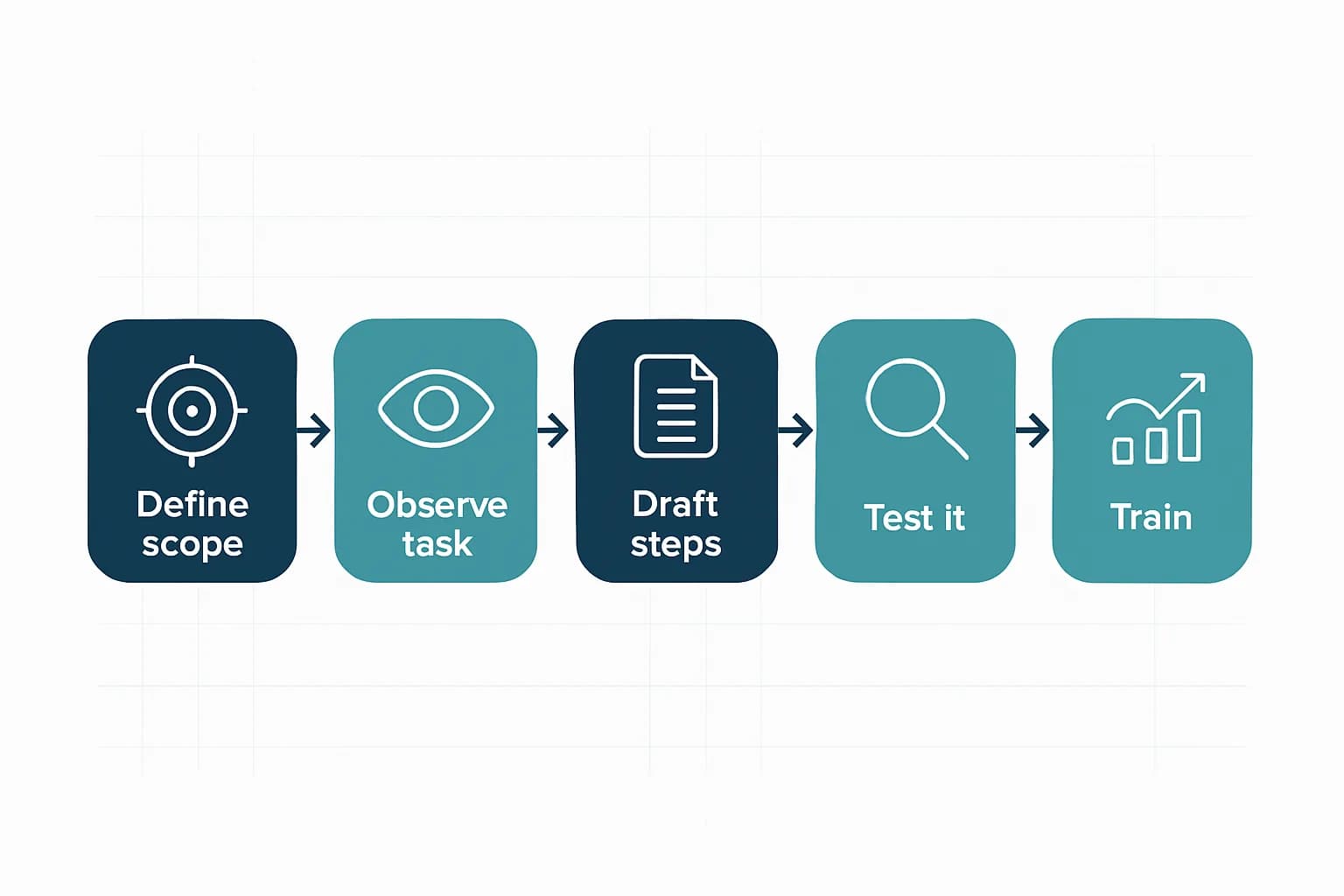
- Define the task and its scope. Pick one procedure with a clear start and end, and write the objective in a sentence. Resist the urge to document a whole department at once. One task, one SOP.
- Involve the people who do the work. The most accurate SOP comes from the operator, the technician, the maintenance lead: the subject matter experts who run the task daily. They know the shortcuts, the gotchas, and the order that actually works.
- Observe and capture the task as it is performed. Watch the work happen and record it, do not reconstruct it from memory at a desk. Note every action, setting, and check in real time. This is where a tool like sopmodo helps: the operator records a voice walk-through on the floor and snaps photos as they go, and you can generate the SOP draft automatically with AI from that capture.
- Draft in plain, imperative language with visuals. Write each step as a short command starting with a verb: "Loosen the four bolts," "Set the temperature to 180 C," "Confirm the gauge reads green." One action per step. Add a photo for anything you would otherwise need a paragraph to describe.
- Test it on someone unfamiliar with the task. Hand the draft to a person who has not done the job and ask them to follow it exactly, doing only what it says. Every place they hesitate, ask a question, or guess is a gap to fix. This single step catches more problems than any amount of rereading.
- Review, approve, and version. Route the corrected draft to the reviewer and approver named in the responsibilities. Stamp it with a version number, a revision date, and a next-review date, then store it where the team will actually look.
- Train and monitor. Walk the team through the approved SOP, then watch how it holds up in practice. If people quietly work around a step, the step is wrong, not the people. Feed that back into the next revision.
Types of manufacturing SOPs
Not every SOP looks the same, because not every task carries the same risk or detail. Knowing the type up front tells you which components to emphasize.
Production and assembly SOPs
These cover how a product is made or put together: setups, changeovers, assembly sequences, and operating a specific machine. They lean heavily on ordered steps, settings, and photos, and they are usually the highest-volume SOPs in a plant.
Maintenance and equipment SOPs
These keep equipment running: preventive maintenance routines, calibrations, lubrication schedules, and repair procedures. Materials and tools, intervals, and clear safety and lockout steps matter most here.
Safety and emergency SOPs
These cover how to work safely and what to do when something goes wrong: PPE requirements, hazardous material handling, lockout/tagout, spill response, and evacuation. The safety and responsibilities components carry the weight, and clarity beats brevity.
Quality and inspection SOPs
These define how you check that output meets spec: inspection routines, sampling, measurement methods, and what counts as a pass or a fail. The quality checks and troubleshooting components are the core, with clear acceptance criteria and a defined path for nonconformances.
Best practices for SOPs people actually use
- Images over words. A clear, annotated photo of the right wire, valve, or reading replaces a paragraph and removes ambiguity. On a noisy floor, people scan pictures, not prose.
- Write for the newest person. Assume the reader has never done the task. Spell out what an expert would consider obvious, and define any term that is not common knowledge.
- One action per step. If a step contains the word "and," it is probably two steps. Short numbered actions are easier to follow and easier to audit.
- Test on the actual floor. A procedure that reads fine at a desk can fall apart at the machine. Validate it where the work happens, with the real tools and conditions.
- Put safety before the risk. Place a warning immediately before the step it applies to, not buried in a section at the top that nobody rereads mid-task.
- Keep it current. Set a review cadence and update the SOP whenever the process, equipment, or materials change. An outdated SOP is worse than none, because people stop trusting all of them.
Frequently asked questions
How long should a manufacturing SOP be?+
Who should write the SOP?+
How often should you update a manufacturing SOP?+
What is the difference between an SOP and a work instruction?+
What is the fastest way to capture a procedure for an SOP?+
The bottom line
Writing a manufacturing SOP comes down to a repeatable sequence: define the task and scope, involve the people who do it, capture the work as it actually happens, draft short imperative steps with photos, test the draft on someone unfamiliar, then review, approve, version, train, and keep it current. Get the components right and follow that order, and you end up with a procedure your team trusts and uses, not one that sits unread in a binder.
Try sopmodo
Turn your next walk-through into an SOP.
Record a task by voice on the floor; review and export the written procedure on the web. Bring it to your whole team.